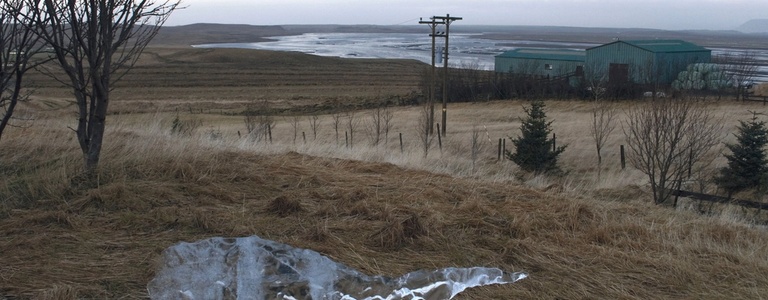
In Melting ice on Gunnar's land, we watch time pass and be measured by the speed at which this piece of glacial ice [changes] from a large chunk to a smaller piece before slowly entirely melting away.
The grid of 12 images before us were taken over a period of some weeks. We see the same trees and landscape in each image. But it's not only the ice that changes. The conditions of weather and light shift and are constantly renewed.
In the first image, the ice itself is lit up by the low golden light of the sun. In the next, the ice is covered by a little sifting of snow that's recently fallen. In other images, there's a mist, or perhaps the water behind looks different as the light changes.
We see a few of the very rare trees in Iceland in this image. The island of Iceland had around 40% tree coverage when Olafur's ancestors first arrived. They used the trees to build their shelters and farms and survive in this extraordinary place. But then there was barely any timber left. The main source of lumber in Iceland for the last few centuries has in fact been the timber that washes up on the beaches as driftwood. We see some of this used in the large artwork suspended above us, Lost Compass 2013. So these trees are quite special.
Another reason I was very keen to include this artwork in the exhibition is because of how it celebrates Olafur's connection and friendship with Gunnar, who was also a very dear friend of his father's. I was lucky enough to visit Iceland with Olafur, and we passed by Gunnar's farm. Olafur pointed it out to me and mentioned the many happy times he'd had there and how important Gunnar was to him, particularly after the death of his father. What I hadn't realised until the exhibition opened was the connection between this photographic series and the image next door, Shadow Stone. Olafur said that to take the picture in Shadow Stone, he'd actually hiked to this site with Gunnar and his father, and it was the last such journey they'd made together before his father died. So I was very pleased that these images, as sad in a way as this story is, convey something of the emotion and human relationships which are so important to Olafur in Iceland, and in the world more broadly.


