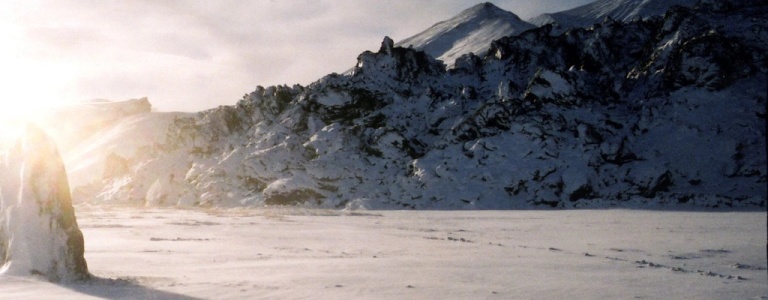
Shadow stone 2006
In a landscape of snow, ice and stone, the light of the sun is radiant and golden, beginning to split into a spectrum of colour as it strikes the tip of a stone. The stone stands alone, creating a long shadow reminiscent of that cast by a sundial.
This image was taken in the middle of the day, around February. Iceland is so close to the North Pole that in winter the sun barely rises above the horizon, and in summer lingers low for extended periods. Speaking of this work, Eliasson describes how light and shadow allow us to not only measure time, but also understand how our body might occupy space:
‘Light is significant in the depiction of spatial depth. The ability to see a space as three-dimensional has to do with our ability to imagine our own body moving through that space. When something is given explicit depth by the sun, it also gives us a different reading of our own body in that space.’– Geraldine Kirrihi Barlow
— Olafur Eliasson